
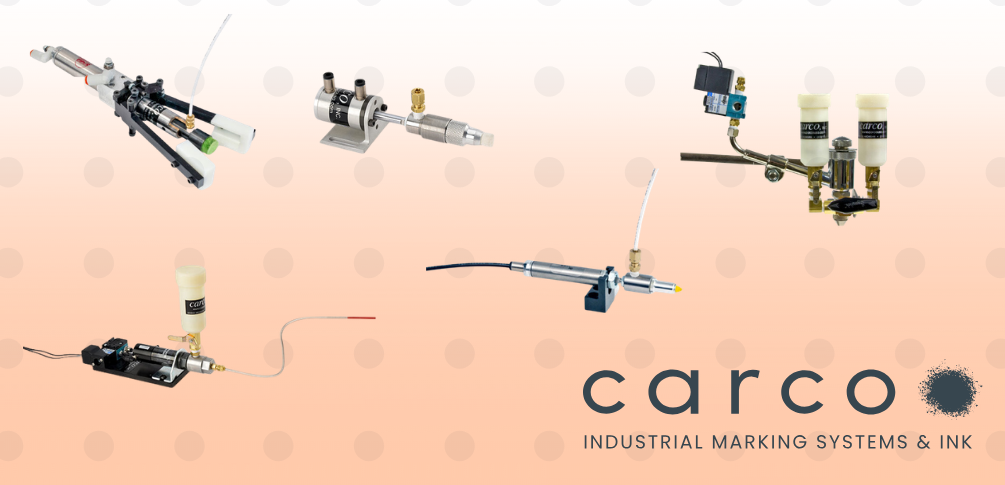
Part marking systems can help improve quality control and enhance process efficiency, but only if they’re designed for the application. Marking head size and shape, mounting blocks, pumps, reservoirs, and other components impact marking uniformity, application repeatability, maintenance requirements, installation ease, and more.
This article covers what to consider before purchasing your next part marking system (and marking inks!).
System
Many factors can influence what part marking system will work best, including application speed and sensitivity, the materials being processed, and the environment that you work in. Before you purchase a part marking system, ask:
Is Your Application Automated?
Part marking systems can be used manually for lower-volume applications or integrated with functionality that enables automation for higher-volume applications. If automation is a necessity, we can integrate PLC controls into the unit to coordinate marking timing and fluid supply.
Can the Marking Head Touch the Products Being Marked?
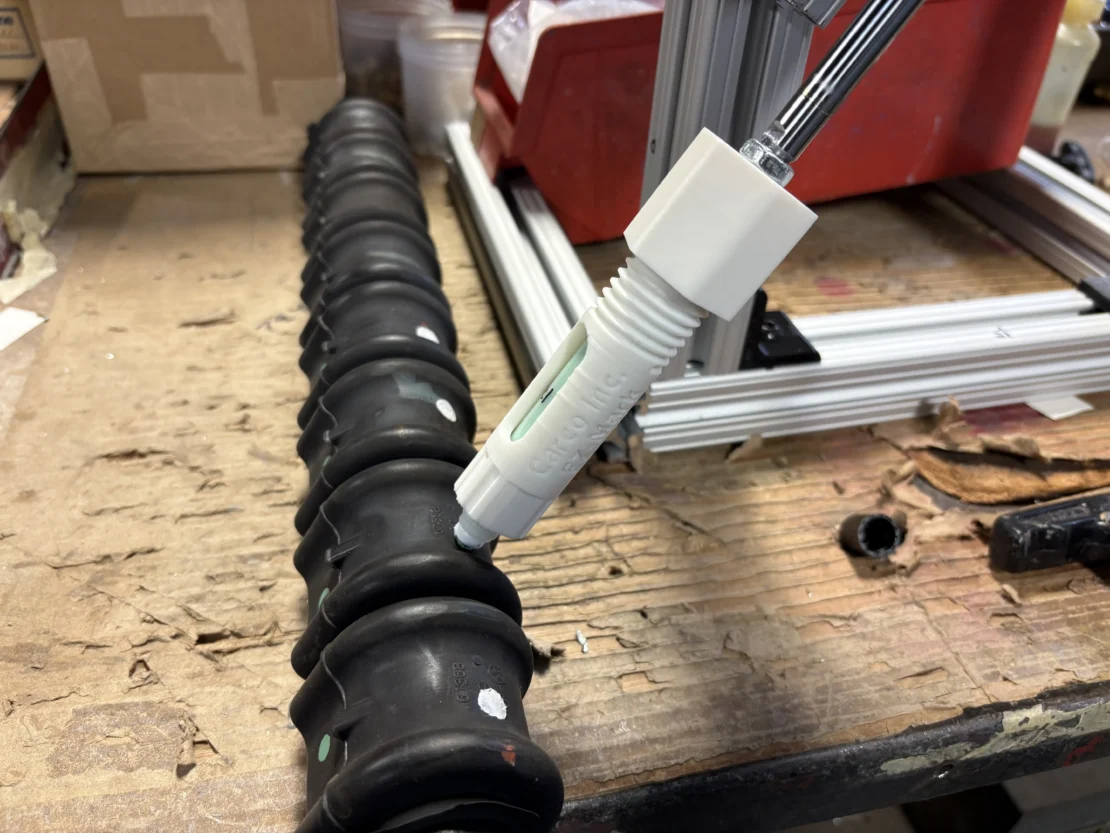
Carco’s systems can be categorized as either contact or non-contact. Our contact systems are better fits for applications where:
- The mark has to survive additional downstream processes
- Rougher surfaces
- Reflective materials
Our non-contact systems are better suited for high-speed applications, environments where contamination risks must be reduced, or when processing fragile and delicate materials.
How Many Parts Do You Need to Mark Between Refills?
How many parts do you need to mark in any given cycle? Most of Carco’s systems can provide rates between 10,000 and 40,000 parts per two ounces of marking fluid.
Our ES-1752 Mini and ES-2100 provide the highest marking volume output for marking applications. Carco also provides 2 oz., 1 qt., and 2 qt. fluid reservoirs, depending on production volume needs.
Does It Need to Be In-Line?
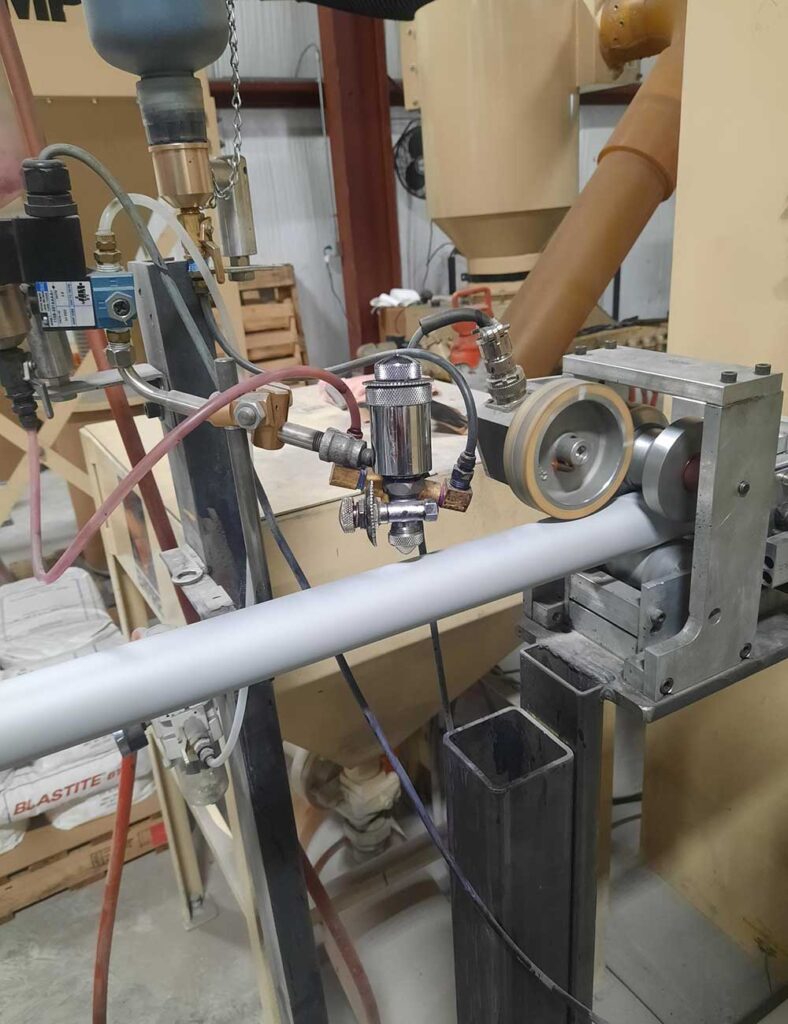
What existing equipment does the part marking system need to interact with? Mounting ease, size, and speed requirements are key factors to look at:
- How will the system need to be mounted?
- How much space do you have to dedicate to the new system?
- How fast will parts come through?
For example, our ES-2100 Rectangular Spring Marker features a double-acting, non-rotating block mount that allows it to be installed in any orientation for easier integration, and it can mark thousands of parts before ink needs to be replaced. However, it has a larger footprint compared to our ES-1518 Mini-Marker, which also features a double-acting, non-rotating block for installation ease. For non-contact applications, our ES-1157 system offers better flexibility when marking objects in hard-to-reach areas and features flexible tubing in varying lengths.
Additionally, we manufacture miniature models for smaller facilities, including the ES-1518 Mini-Contact, ES-1752 Mini Contact, ES-2618 Mini-Contact Marker With Cover Assembly, and the ES-400 Mini-Spray System.
Is Your Environment Harsh?
Dust and debris can contaminate the marking head and impact the uniformity and visibility of marks. If you’re in a high-debris or high-contaminant environment and have a contact marking application, we recommend our ES-712 and ES-2618 Mini, both of which have integrated cover assemblies that protect the marking head when it’s not being used.
Environment, particularly chemical exposure and moisture content, also influences marking ink selection.
What Size & Shapes of Markings Do You Need?
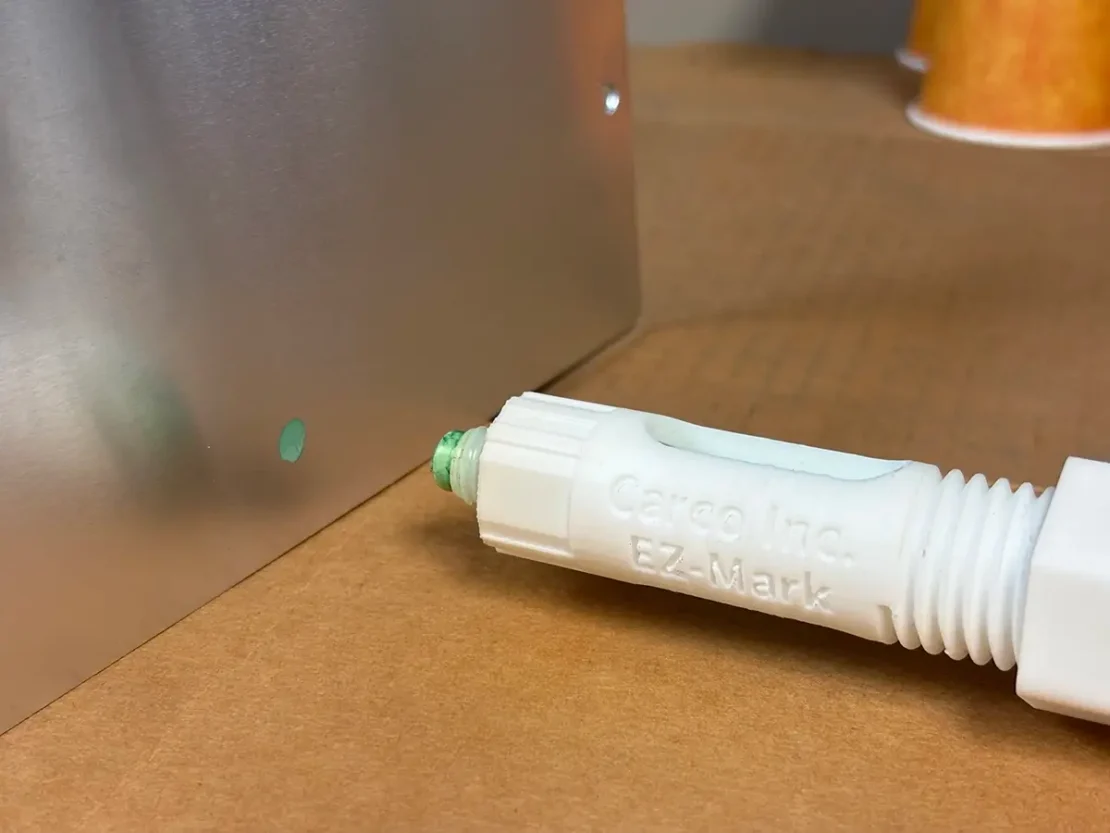
Carco’s systems can deliver marks as small as 1/8” and as large as 1.5”. Our original classic ES-612 contact model offers the best size variety (1/8”, 1/4”, 1/2”, 3/4”, 1”, and 1.5”), while our ES-800 Spray System (Non-Contact) model provides different sizes and shapes of marking.
Some of our systems deliver small, tightly controlled dots or larger stripes, depending on application needs. Our contact systems deliver precise dots, with the exception of the ES-2100, which provides rectangular markings. Most of our non-contact systems feature adjustable spray patterns to deliver a variety of patterns, with our ES-1157-C Jet Shot delivering the best precision and control for non-contact applications.
What Type of Material(s) Are You Marking?
Material influences both system and required marking inks. When selecting a system, consider:
- Is the material reflective/shiny?
- Is the material a darker color?
- Will it be wet or exposed to water?
- Will it be exposed to chemicals?
- What other downstream processes will it be exposed to? (Heat treatments, etc.)
- Will the material be moving? If so, how quickly?
- Is the material delicate or fragile?
- Is contamination a risk?
- Is the material porous?
Our non-contact systems, including the ES-400 Mini, ES-800 Series, and ES-1157-C-Jet Shot, are designed for fast-moving, higher-volume products, with our ES-1010 Low Pressure Spray System being the better option for fast-moving fragile parts.
Additionally, certain formulas, like our dye-type inks, are transparent and work particularly well on shiny and/or light-colored surfaces, but they won’t mark darker substrates as good as our pigmented inks.
Marking Inks
Marking ink selection is just as important as the unit. Knowing what type of ink your application requires, whether water-based or solvent-based, can limit available part marking systems simply based on compatibility.
Do You Require Permanent Markings?
Our MM-140, MM-150, SG-1260, and WS-800 marking inks work best for non-contact applications requiring wash-resistant permanent markings, while our 1000-HF, F-123, F-224, and SG-1290 are better suited for contact marking applications.
Are There Security Concerns?
Carco engineers specialty marking fluids for higher-security inventory tracking and quality control applications that require discreet markings. If your application falls under this, consider using our UV fluorescent inks, which appear invisible on all substrates until exposed to 365nm UV light. This ink is compatible with any automated marking system manufactured by Carco, and available in fast-drying formulations.
How Quickly Will Markings Need to Dry?
Our inks have drying times ranging from as little as 10 seconds to as long as two hours. Water-based inks will take longer to dry, with our quickest-drying formula offering a 20-minute minimum dry time. Many of our solvent-based and dye-type inks offer faster dry times.
- Fastest-Drying Formulas: 1044 (10 Seconds) and XX-1346 (10 Seconds), only compatible for non-contact applications.
- Runner-Ups: 1000-I (Dye-Type, 30-60 Seconds, Non-Contact), MM-140 ( Solvent-Based, 30-60 Seconds, Non-Contact), MM-150 (Solvent-Based, 30-60 Seconds, Non-Contact)
- Fast-Drying Formula for Contact Applications: F-123 (Solvent-Based, 2-3 Minutes)
Need Help Selecting a Product?
Carco’s contact and non-contact part marking systems are highly customizable. Every model is designed for use in manufacturing and industrial environments and compatible with most of our marking inks. Stroke lengths and nib sizes come in varying sizes, and most models can be equipped with optional Hall effect switches or magnetic reed cylinders.
You can contact us by phone at (313) 925-9000, or fill out our online form with your application details for product selection assistance and customization recommendations.